 The Cashmere Coat
Most coats sold as “handmade” are machine-made with a few hand-finished touches at the end. “Fully hand-sewn” claims something stronger: the seams that decide how a coat hangs, rolls and ages are sewn by a person with a needle, not fed through a machine. This page explains where the handwork actually lives in a coat, why it changes the garment, and how to check a sample before you believe the claim — it is the standard our own coats are made to, and the one we would want buyers to hold us to.
Hand-finished is not hand-sewn
In most factories, “handmade” means the structural sewing is done by machine and hands appear only at the end: sewing on buttons, tacking the lining, final pressing. There is nothing dishonest about that — until the word is used to price the coat as if it were tailored. A fully hand-sewn coat is different in kind: the lapel, collar, buttonholes, lining and edges are shaped by hand stitching, the way a tailor works. You can read the full picture of how our coats are made on the craft page.
The five places handwork actually lives
- Buttonholes. A hand-worked buttonhole is cut, then bound with dense stitches that slightly raise the edge. It flexes with the button instead of fraying against it — on a coat that opens and closes daily, this is the first place machine work shows its age.
- Lapels. Hand pad-stitching sews the lapel to its canvas with rows of small diagonal stitches. That is what gives a lapel its soft, three-dimensional roll. A machine-fused lapel is pressed flat and stays flat.
- The collar. Set and felled by hand, a collar can be eased millimetre by millimetre so it hugs the neck without a gap — the detail customers notice in the mirror without knowing why.
- The lining. Hand-felled lining is attached with small slanting stitches that leave the lining a fraction loose, so the coat moves over clothing instead of pulling against it.
- Edges and corners. Hand-finished edges and corners sit cleaner because the tailor turns and judges each one individually, rather than trusting a folder attachment to do it at speed.
Why it matters beyond the story
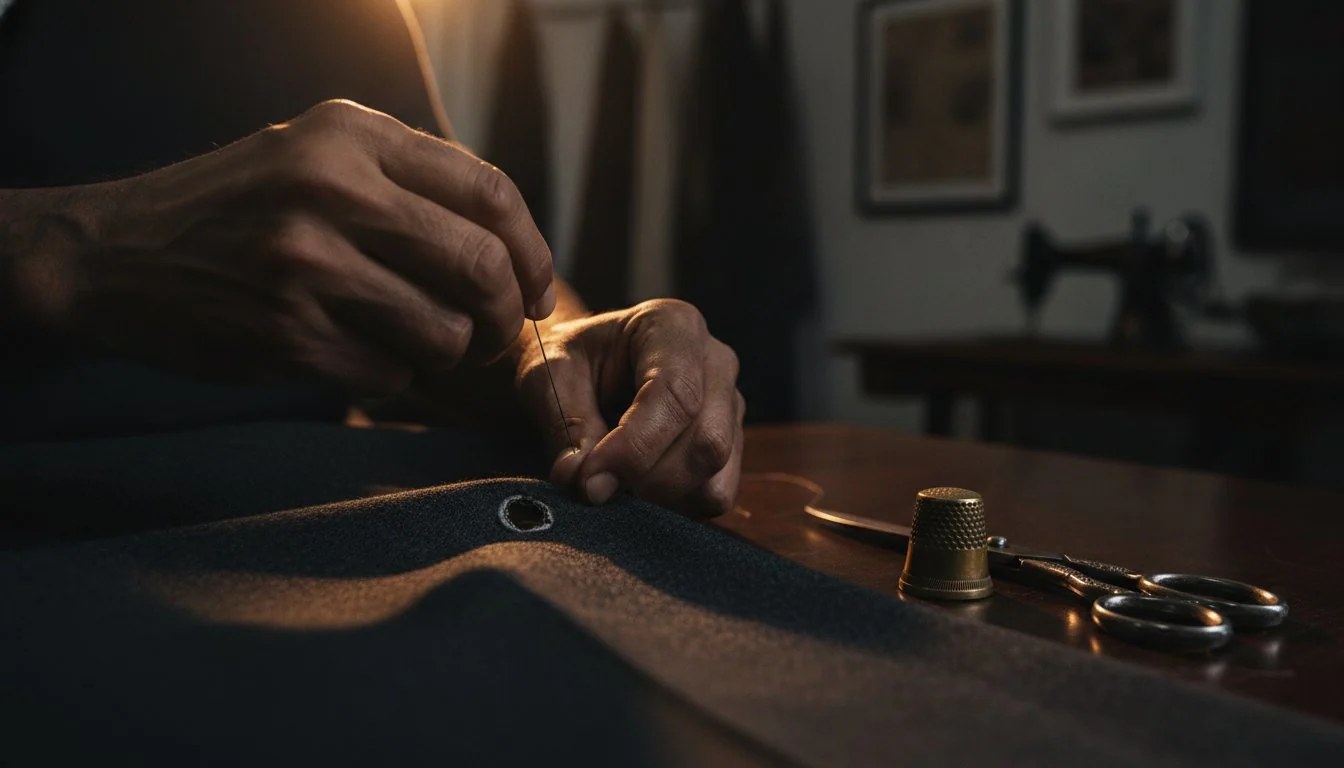
Hand stitching is done at variable tension — the tailor eases fabric as they sew, so curves stay curved and the coat keeps a body-shaped, three-dimensional form instead of a pressed-flat one. Seams sewn by hand also fail gracefully: a loose stitch can be re-sewn by any tailor, anywhere, which makes a hand-sewn coat repairable for decades rather than disposable. And for a store or a label, it is a claim your customers can verify with their own eyes in ten seconds — which is more than most marketing copy offers. Our current styles, all made this way, are in the collection.
How to check a sample in ten seconds
- Run your eye along any visible seam: perfectly identical stitches are machine work; slight, living variation is a needle.
- Bend the lapel: a hand-padded lapel rolls softly and springs back; a fused one creases.
- Turn the coat inside out: hand-felled lining shows small slanting stitches, not a single machine line.
- Work a buttonhole: hand-worked edges feel dense and slightly raised, never raw.
If you are ordering for a store or your own label, this check is why we work sample-first: one finished coat, in your hands, before bulk production. The ordering route is on the private label page, and common questions are answered in the FAQ.
FAQ
What is the difference between hand-finished and fully hand-sewn?
Hand-finished means a machine made the coat and hands added the final touches — buttons, linings, pressing. Fully hand-sewn means the seams that give the coat its shape are themselves sewn by hand: lapels pad-stitched by hand, collars set by hand, buttonholes worked by hand. The first is decoration; the second changes how the coat drapes and ages.
How can you tell if a coat is really sewn by hand?
Look closely at the stitching. Hand stitches are never perfectly uniform — tiny variations in length and tension are the signature of a needle, not a machine. Check the buttonholes (dense, slightly raised hand-worked edges), the lapel (a soft roll instead of a pressed-flat fold) and the lining (felled by hand with small, slanting stitches).
Why does hand-sewing cost more?
Because time is the material. A machine sews a seam in seconds at one fixed tension; a tailor spends minutes per seam, easing the fabric as they go so the coat keeps a three-dimensional shape. You are paying for skilled hours, and for a coat that can be repaired and re-shaped instead of replaced.