 The Cashmere Coat
Private label, the way we run it, is deliberately boring: you choose a proven coat, we make one finished sample with your label in it, you check that sample like a contract, and only then does bulk production exist. No catalogue promises, no bulk commitment up front. Here is the process step by step, including what we need from you and what you should demand from any supplier — us included.
What “private label” means here
Our styles already exist as finished garments — the men’s and women’s coats in the collection, fully hand-sewn in our own factory. Private label means those coats carry your brand: your woven label, your hangtags, your packaging. It is the fastest honest route to a cashmere coat with your name in it, because the product risk has already been taken out — what remains is checking that we make it exactly as agreed.
The five steps
- 1. Choose the style and fabric. Pick the coat, and the composition you want to sell — 100% cashmere, or a declared blend such as 10% cashmere / 90% wool. If you are weighing the two, cashmere vs wool, read properly, is the five-minute version.
- 2. Send your size chart and label artwork. Your sizes, your label. Coats are made to your chart, not to ours.
- 3. We make one finished sample. A complete coat — not a mock-up — with your label sewn in, made the same way bulk will be made: fully hand-sewn, as described on the craft page.
- 4. You check the sample. Fabric, label, construction, measurements. Run it like a buyer: the sample checklist is the exact sequence. Approve it, or tell us what to fix and we remake it.
- 5. Bulk follows the approved sample. The sample you approved is the standard; bulk pieces are checked against it. Your approved sample stays the reference for every later order of that style.
What it costs you to start
Your time and one sample — that is the design of the process. The expensive mistakes in clothing sourcing happen when a buyer commits to bulk on the strength of photos and a video call. A finished sample in your hands, checked against a written checklist, removes nearly all of that risk before real money moves. Questions about samples, labels and shipping are answered on the FAQ page.
When you are ready, send us the style, your size chart and your label artwork through the inquiry form or WhatsApp, and we will come back with the sample quote. One coat first. Then decide.
FAQ
What does private label mean for your coats?
It means our existing, proven styles made with your brand’s label, hangtags and packaging. You are not paying to develop a garment from zero — you are putting your name on a coat that already exists as a finished, checked product.
Do I have to commit to a bulk order to get a sample?
No. The process starts with one finished sample, made to your size chart with your label. You check it in your own hands first, and only an approved sample leads to a bulk order.
What do you need from me to start?
Four things: the style you want from the collection, your size chart, your label artwork, and the fabric composition you are targeting (for example 100% cashmere, or a declared cashmere–wool blend). With those, a sample can be made and quoted.
A sample is not a preview — it is the contract your bulk order will be judged against. So check it like one. This is the exact sequence our own quality team expects a buyer to run on a coat sample, in the order that catches expensive problems earliest: paperwork and fabric first, then construction, then fit. It works for any supplier; it is also precisely how a sample from us is built to be checked.
Step 1 — The label, before anything else
- Read the composition label and compare it, word for word, with what you ordered. Percentages in descending order; the shell and the lining declared separately. (If label language is new to you, start with how to read a coat label.)
- Check your own branding: your label, spelled right, sewn straight, in the agreed position.
- Keep the paperwork with the sample: the agreed composition and size chart are part of the sample, not admin.
Step 2 — Fabric checks (five minutes, no tools)
- Hand feel. Cashmere should feel soft and warm at first touch, never slippery or squeaky.
- Stretch and recovery. Gently stretch a small area at the back. It should spring back, not stay bagged.
- Surface. Hold the coat against the light. Uneven fuzz, thin patches or a shiny pressed stripe mean the fabric or the pressing is off.
- Colour. Check the colour in daylight, not only under shop lights — camel and grey shades shift the most between the two.
Step 3 — Construction checks
This is where a fully hand-sewn coat separates itself, and where our guide to what “fully hand-sewn” actually means gives the full picture. The short version:
- Buttonholes dense and slightly raised, with no raw edges.
- The lapel rolls softly instead of folding flat, and springs back when bent.
- The collar sits against the neck line with no gap and no pucker.
- Inside, the lining is felled with small slanting hand stitches and hangs a fraction loose, never drum-tight.
- Seams lie flat with slight, living variation in the stitches — identical, laser-straight stitching is machine work, whatever the brochure says.
Step 4 — Fit and finish
- Measure chest, garment length, shoulder and sleeve against your size chart, and note the direction of any difference, not just its size.
- Hang the coat for a day, then look again: shoulders should sit clean, fronts should hang level, the vent should stay closed.
- Try every button and pocket. Buttons should be sewn with a thread shank, not pulled flat against the fabric.
- Smell the coat. Strong chemical odour at sample stage will still be there at bulk stage.
The decision: approve, fix, or walk away
Approve when fabric, construction and measurements all match the agreement — then say so in writing and keep the sample as your reference standard. Ask for a fix when the fabric is right but a detail is wrong: a measurement that drifts one way, a collar that gaps. Those are pattern and workmanship corrections, and a serious factory will remake the sample. Walk away when the fabric itself is not what was declared — a sample is the best a supplier will ever send you, and bulk never improves on it.
Ready to run this checklist on a real coat? Our ordering route starts with exactly one finished sample, made to your size chart and checked by you before anything else happens — see private label ordering or the FAQ.
FAQ
What should I check first on a coat sample?
The label and the fabric, before the fit. Confirm the composition label matches what you ordered — percentages, in descending order — then run the fabric checks: hand feel, stretch recovery, and a close look at the surface. A sample that fails on fabric will not improve in bulk.
How do I know the bulk order will match the sample?
Agree the sample as the reference standard in writing, keep one approved sample on your side, and check the first bulk pieces against it point by point — fabric, stitching, measurements. That is why sample-first ordering exists: the sample is the contract.
What measurement tolerance is normal on a coat sample?
Small tolerances are normal in tailored garments because fabric is soft and measured by hand; what matters is that the sample follows your size chart consistently across chest, length, shoulder and sleeve. Flag any point that is off in the same direction everywhere — that is a pattern issue, not a measuring issue.
Most coats sold as “handmade” are machine-made with a few hand-finished touches at the end. “Fully hand-sewn” claims something stronger: the seams that decide how a coat hangs, rolls and ages are sewn by a person with a needle, not fed through a machine. This page explains where the handwork actually lives in a coat, why it changes the garment, and how to check a sample before you believe the claim — it is the standard our own coats are made to, and the one we would want buyers to hold us to.
Hand-finished is not hand-sewn
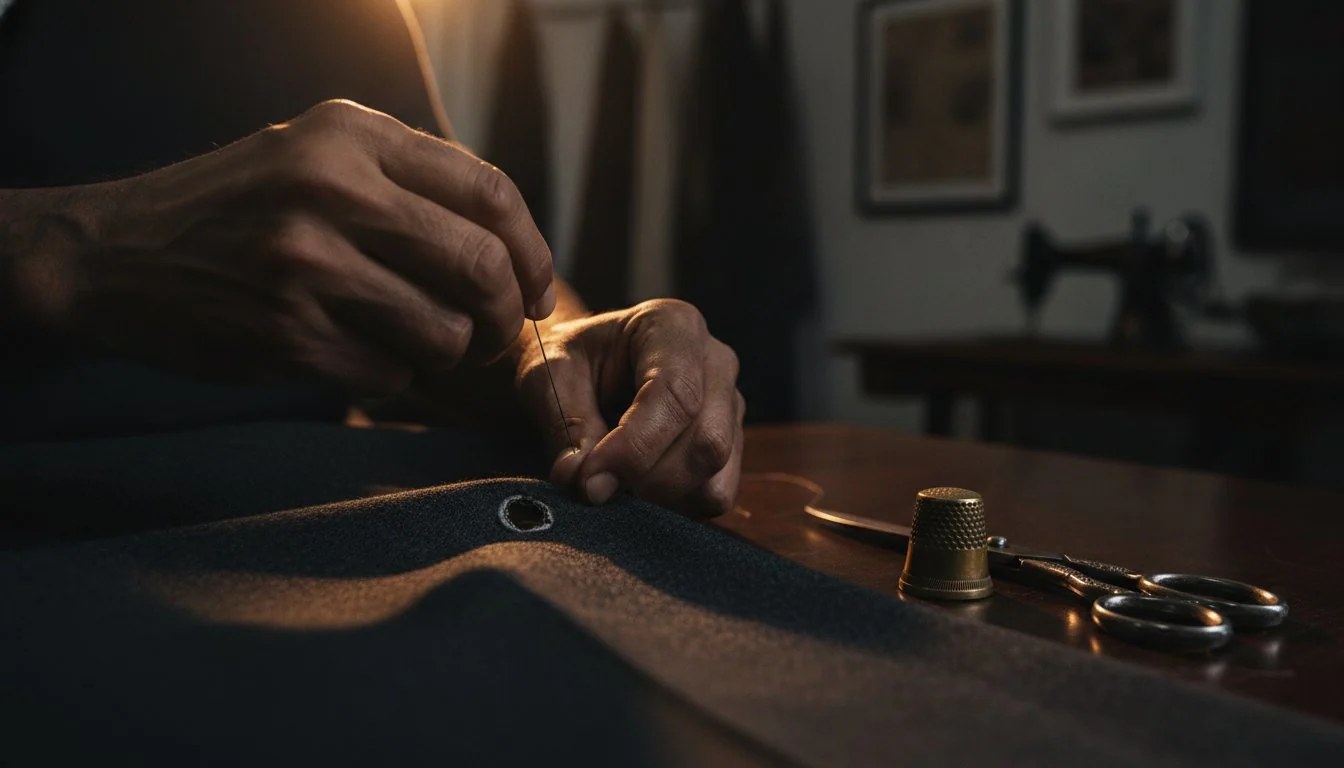
In most factories, “handmade” means the structural sewing is done by machine and hands appear only at the end: sewing on buttons, tacking the lining, final pressing. There is nothing dishonest about that — until the word is used to price the coat as if it were tailored. A fully hand-sewn coat is different in kind: the lapel, collar, buttonholes, lining and edges are shaped by hand stitching, the way a tailor works. You can read the full picture of how our coats are made on the craft page.
The five places handwork actually lives
- Buttonholes. A hand-worked buttonhole is cut, then bound with dense stitches that slightly raise the edge. It flexes with the button instead of fraying against it — on a coat that opens and closes daily, this is the first place machine work shows its age.
- Lapels. Hand pad-stitching sews the lapel to its canvas with rows of small diagonal stitches. That is what gives a lapel its soft, three-dimensional roll. A machine-fused lapel is pressed flat and stays flat.
- The collar. Set and felled by hand, a collar can be eased millimetre by millimetre so it hugs the neck without a gap — the detail customers notice in the mirror without knowing why.
- The lining. Hand-felled lining is attached with small slanting stitches that leave the lining a fraction loose, so the coat moves over clothing instead of pulling against it.
- Edges and corners. Hand-finished edges and corners sit cleaner because the tailor turns and judges each one individually, rather than trusting a folder attachment to do it at speed.
Why it matters beyond the story
Hand stitching is done at variable tension — the tailor eases fabric as they sew, so curves stay curved and the coat keeps a body-shaped, three-dimensional form instead of a pressed-flat one. Seams sewn by hand also fail gracefully: a loose stitch can be re-sewn by any tailor, anywhere, which makes a hand-sewn coat repairable for decades rather than disposable. And for a store or a label, it is a claim your customers can verify with their own eyes in ten seconds — which is more than most marketing copy offers. Our current styles, all made this way, are in the collection.
How to check a sample in ten seconds
- Run your eye along any visible seam: perfectly identical stitches are machine work; slight, living variation is a needle.
- Bend the lapel: a hand-padded lapel rolls softly and springs back; a fused one creases.
- Turn the coat inside out: hand-felled lining shows small slanting stitches, not a single machine line.
- Work a buttonhole: hand-worked edges feel dense and slightly raised, never raw.
If you are ordering for a store or your own label, this check is why we work sample-first: one finished coat, in your hands, before bulk production. The ordering route is on the private label page, and common questions are answered in the FAQ.
FAQ
What is the difference between hand-finished and fully hand-sewn?
Hand-finished means a machine made the coat and hands added the final touches — buttons, linings, pressing. Fully hand-sewn means the seams that give the coat its shape are themselves sewn by hand: lapels pad-stitched by hand, collars set by hand, buttonholes worked by hand. The first is decoration; the second changes how the coat drapes and ages.
How can you tell if a coat is really sewn by hand?
Look closely at the stitching. Hand stitches are never perfectly uniform — tiny variations in length and tension are the signature of a needle, not a machine. Check the buttonholes (dense, slightly raised hand-worked edges), the lapel (a soft roll instead of a pressed-flat fold) and the lining (felled by hand with small, slanting stitches).
Why does hand-sewing cost more?
Because time is the material. A machine sews a seam in seconds at one fixed tension; a tailor spends minutes per seam, easing the fabric as they go so the coat keeps a three-dimensional shape. You are paying for skilled hours, and for a coat that can be repaired and re-shaped instead of replaced.
Short answer: the word on the hangtag is marketing; the fibre label inside the coat is the fact. A “cashmere coat” can be 100% cashmere, a 10% cashmere / 90% wool blend like our camel style, or almost anything in between — and each behaves, wears and costs differently. This guide is the 30-second label check our own buyers run, plus the cashmere vs wool differences that actually matter when you are choosing coats for a store or a label.
The 30-second label check
Turn the coat inside out and find the composition label. Three things to read, in order:
- The percentages. Fibres are listed in descending order by weight. “100% cashmere” is a single-fibre fabric. “10% cashmere, 90% wool” is a wool coat improved by cashmere — a good fabric, but price it as a blend, not as cashmere.
- The wording traps. “Cashmere feel”, “cashmere touch” and “contains cashmere” (with no percentage nearby) are not composition claims. If no percentage is printed, assume the cashmere share is small.
- Lining and shell are labelled separately. A cashmere shell over a synthetic lining is normal at many price points — just make sure the percentage you are paying for refers to the shell fabric, not the whole garment.
On our own line we sell both ends of this honestly: pure cashmere styles, and a camel blend at 10% cashmere / 90% wool that we label exactly that way. You can see both in the collection.
Cashmere vs wool: what actually differs
Cashmere is the fine undercoat fibre of the cashmere goat; wool is sheep fibre. Cashmere fibres are much finer (roughly 14–19 microns against 20–40 for most wool) and shorter. Finer means softer and warmer for the same weight — and more delicate. Shorter means the fabric pills more easily at first and costs more to spin well. Everything in the table below follows from those two facts.
| 100% cashmere | Cashmere–wool blend | 100% wool | |
|---|---|---|---|
| Hand feel | Softest, almost weightless on the skin | Soft with more body; the wool adds structure | Firmest hand; can feel prickly in coarse grades |
| Warmth for its weight | Highest — fine fibres trap the most air | High, slightly heavier for the same warmth | Warm, but needs more weight to match cashmere |
| Drape | Fluid, follows the body | Holds a tailored line better than pure cashmere | Most structured; sharp lapels and shoulders |
| Wear behaviour | Short fibres can pill early, then settle | Generally the most forgiving day to day | Hard-wearing; pills less in long-staple grades |
| Price driver | Fibre cost dominates — the most expensive option | Scales with the cashmere share | Most accessible of the three |
| Best for | Premium lines, statement pieces | Core retail ranges that must balance feel and margin | Workhorse coats, sharper tailoring |
How to tell if the cashmere is real
No single home test is proof, but together these catch most problems:
- Touch. Real cashmere feels soft and warm immediately, never slippery or squeaky — slipperiness often means a synthetic coating or content.
- Stretch and recovery. Gently stretch a small area of fabric. Cashmere springs back; stretched-out, lifeless fabric suggests weak or substituted fibres.
- The first wears. Light pilling in friction areas is normal for real cashmere and settles down. Heavy pilling across the whole garment in the first week points to very short fibres.
- For trade orders, paperwork beats tests. Ask the supplier for the fabric composition and a test report, approve a physical sample, and check bulk production against that sample. That is exactly how we work: one finished sample first, checked by you, before any bulk order — see how private label ordering works.
What this means when you buy wholesale
Choose the fabric for the customer, not for the hangtag. If your range sells on luxury hand feel, buy 100% cashmere and price for it. If you need a coat that survives daily wear at a mid-market price, a declared cashmere–wool blend is usually the better business decision — it keeps its shape, resists wear, and still gives the customer the word “cashmere” on a truthful label. What you should never do is pay 100% cashmere money for an undeclared blend; the label check above is how you avoid it.
Questions buyers usually ask next are answered on our FAQ page — samples, your own labels, and shipping. Or send us your target composition and we will quote the fabric honestly, as a sample first.
FAQ
Is a cashmere blend coat worse than 100% cashmere?
Not necessarily. A blend trades a little softness for body, durability and a lower price point. Many retail ranges sell better as blends because the coat keeps its tailored shape longer. What matters is that the label states the true percentages.
How can you tell if a cashmere coat is real?
Start with the fibre label: real products declare exact percentages. Then check the fabric — genuine cashmere feels soft without slipperiness, springs back when gently stretched, and pills only lightly in the first wears. For wholesale orders, ask the supplier for the fabric composition and a test report, and compare the bulk goods against the approved sample.
Why do two “cashmere coats” cost so differently?
Because the name covers very different fabrics: 100% long-fibre cashmere, short-fibre cashmere, and blends with 10% or less cashmere all reach the shelf as “cashmere coats”. Fibre share, fibre length and construction — fully hand-sewn versus machine-made — explain most of the gap.